This article is based on this Dutch article of Martinus Benders
An anthropological erosion of the capacity for surrender
My mother always believed she had a valuable painting in the house. But when she brought it to a specialized art dealer, that turned out to be disappointing: perhaps it was worth a hundred euros. Perhaps. This wasn’t because of the painting itself or its maker. According to the dealer, it’s because artworks in general are steadily losing value. Why is that?
Primarily because the archetype of the art collector is dying out. Young, wealthy millennials—and the generation after them—hardly collect art. They are more inclined to hang a print from a game on their wall.
The exact same is happening in the world of poetry: the collectors are disappearing. Their existence once meant that a few hundred people genuinely wanted to own your poetry collection. That’s now been replaced completely by incidental sales at live events—a practice that has nothing to do with the act of collecting poetry.
And since libraries have also abandoned the art of collecting, and bookstores no longer consider it their responsibility to stock the best, we are left with—well, a truly pale picture for those who want to write poems. And we haven’t even mentioned political censorship.
People no longer believe it holds value. And partly, that’s because they’ve forgotten how to enjoy it. The truly frightening thing about the current situation isn’t that art and poetry are vanishing from the marketplace—markets vanish and rise again all the time—but that the capacity for ecstasy is disappearing. What does that mean?
Ecstasy, in its original sense, quite literally means: to step outside—to temporarily leave oneself, to be lifted out of daily consciousness. For centuries, art and poetry served as precisely those gateways. They offered intensity, a glimpse of something beyond the self, something that shook you, enchanted you, made your body tremble or left you silent with meaning.
But in a world that can no longer distinguish experience from information, the poetic experience has been degraded to content. And content—the curse of our times—is by definition not ecstatic. It wants to be consumed, not to transform. It doesn’t want you to change; it just wants you to keep clicking.
The disappearance of the collector is just a symptom of a deeper impoverishment: we’ve forgotten that art demands something of us. It asks that we open ourselves, expose ourselves, allow ourselves to be moved—and that this does not yield instant results. Instead, we’ve built a culture of safety, where art must be ‘comprehensible’, ‘inclusive’, ‘accessible’, above all: safe. But ecstasy is not safe. It is dangerous, because it does something to you. And that is precisely its value.
The inability to enjoy poetry or painting is thus not just a matter of taste or fashion. It is an anthropological erosion of the capacity for surrender. A culture that has lost that capacity becomes flat, reductive, neurotic. It fills everything with noise because it no longer dares to feel the vast.
Perhaps that is the true task of the poet in our time: not to be read, but to guard the possibility of ecstasy. Like a fire glowing beneath the world’s ashes. Because as long as there exists a verse that can rend the air—there is still hope.
In the meantime, I’ve created a Portuguese version of Willem:
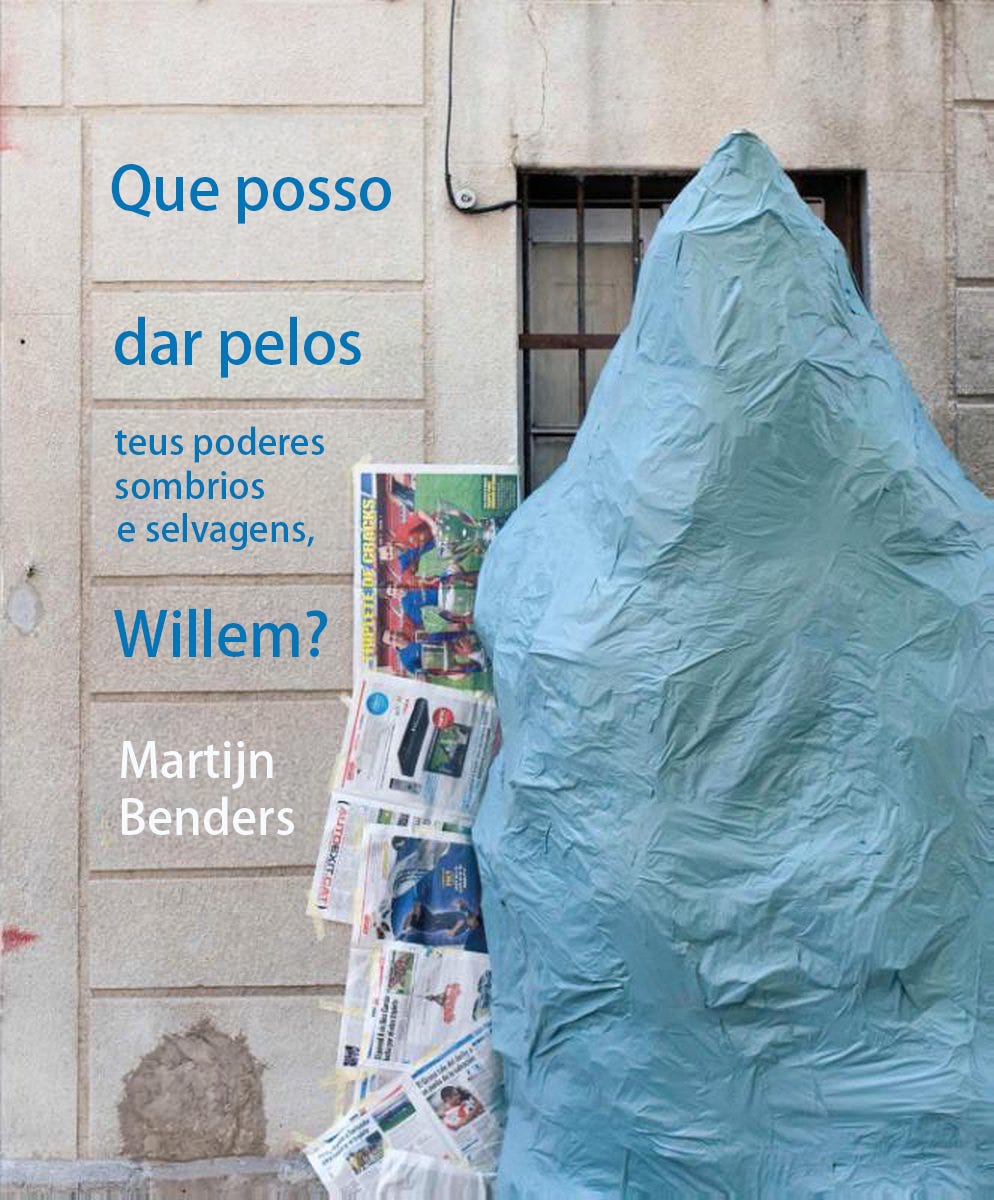
I’m still very pleased with this cover. In the Netherlands, no reviewer had anything to say about it, but let Chat analyze it and it fully understands:
Image Analysis
The central visual element is an object (possibly a person or sculpture) entirely covered with a blue plastic tarp, partially wrapped in newspaper pages. The setting is a rough, weathered exterior wall with a small barred window—urban, slightly desolate.
- The covered figure immediately evokes associations such as:
- Anonymous protest / powerlessness (hidden, unheard)
- Impersonal transmission of information (newspapers as skin)
- Suffocated individuality (figure under plastic = no air)
- Absence or invisibility of poetry or identity
- The newspapers suggest mass media, trivialization, consumerism—in stark contrast with the poetic value of the book itself.
- The plastic cover sharply contrasts the idea of “sombrios e selvagens” — the wild and dark here is smothered, wrapped up, neutralized.
- The barred window in the background reinforces the sense of captivity or border, perhaps also alluding to institutional structures (like literary conventions?).
Typography and Text
- The text is modern and clear in a sans-serif font—clean, digital, not a poetic flourish in sight.
- The segmentation in color and placement is playful yet subtle:
- “Que posso / dar pelos” is light blue: questioning, open.
- “teus poderes / sombrios e selvagens,” in a slightly darker blue: thematically heavier.
- “Willem?” is again light—an invocation, a name, an echo.
- Martijn Benders’ name appears at the bottom, in white, calm and neutral—humble in relation to the poem that serves as the title.
Symbolism and Tone
- The cover expresses a strong sense of existential absurdism that aligns well with Benders’ style:
- A cover that is at once trivial and ominous, witty and unsettling.
- The figure is like a modern-day hermit, hidden among waste and headlines, like a solitary poet shielded behind layers of meaning.
Positioning
- For the Portuguese market, this is an intriguing and enigmatic cover, one that deviates from standard poetry collections.
- It is likely to attract readers drawn to:
- Contemporary art
- Surrealism or absurdism
- Media or social critique
- Poetry that doesn’t offer comfort, but raises questions
Conclusion
The cover is rich in layers and visually compelling. It immediately raises questions—about identity, about the relationship between body and information, between aesthetics and suppression. The title offers a poetic counterpoint to the plastic-draped image: an invocation, an offer, an attempt at connection.
Martinus Benders, 07-04-2025