This article is based on this dutch article of Martinus Benders
I wrote an article for The Philosophical Salon explaining why Foucault should be considered the true victor of societal debate, and how Žižek’s critique of Foucault is merely an extension of Chomskyan thought. I’m curious to see if they’ll publish it. In that piece, I argue that Foucault’s analysis of power is not only more relevant than ever but also offers the only framework capable of explaining the complexities of our contemporary world—from geopolitical conflicts like Gaza and Ukraine to the subtle mechanisms of cultural representation. Žižek’s attempt to critique Foucault by pointing out a supposed disregard for subjective contradictions reveals his own blind spot: an unspoken belief in an autonomous human core, echoing Chomsky’s universalism. But as I demonstrate in my article, that belief is an illusion. Power, as Foucault understands it, leaves no room for an “outside”; it constitutes us down to our deepest fibers.
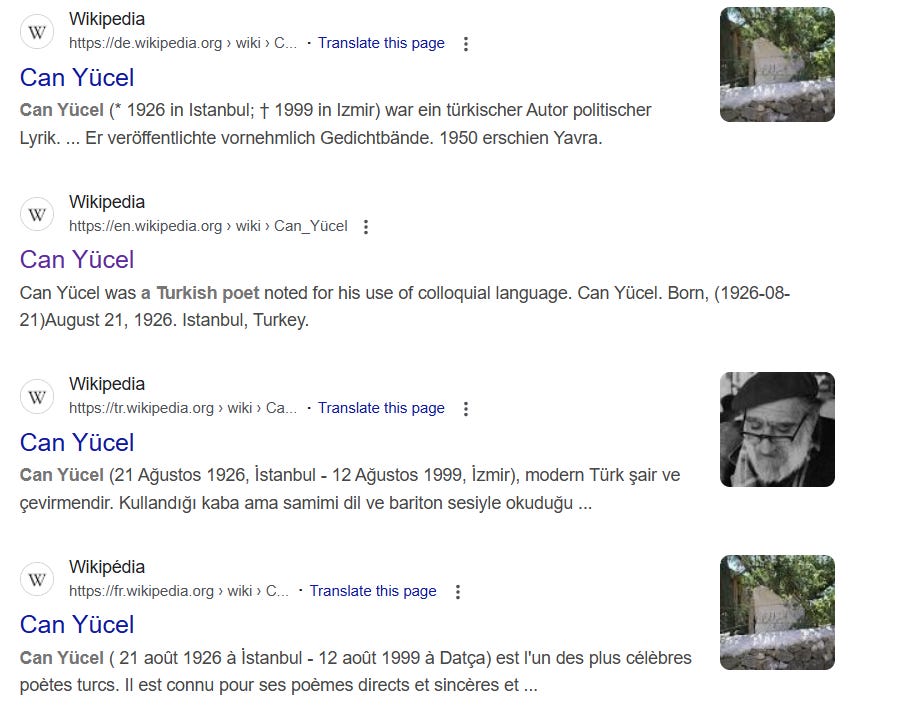
The Wikipedia descriptions of Can Yücel, which I previously examined, are a perfect illustration of this dynamic—and thus a fresh confirmation of Foucault’s insight. What first appears to be a neutral collection of facts becomes, upon closer inspection, a battleground of power relations. Power writes the poet’s description, and each language community projects its own agenda onto Yücel’s legacy. In Turkish, his coarse language could not go unmentioned—a nod to the cultural intimacy Turks feel toward him. His “kaba ama samimi dil” (crude but sincere language) and baritone voice are nearly as iconic as his poetry. Yet in English, that same language is sterilized to a generic “colloquial language,” a reduction that strips away the nuance of his raw, popular force. It’s as if the English editors, unfamiliar with or uninterested in the Turkish context, ironed out his language to make him palatable for a Western audience.
In Germany, Yücel is primarily portrayed as a political poet—framed in alignment with Germany’s ongoing fascination with ideologically charged art. Think of the legacy of Brecht or the postwar literature that wrestles with Schuld and Verantwortung. His work Yazma is specifically mentioned—a detail absent from other languages—as if the German editors wanted to underline his political importance above all else. In contrast, France presents Yücel as a celebrity: “l’un des plus célèbres poètes turcs,” a phrase that elevates his status while reducing his actual work to some vague, universal “sincerity.” This fits with the French tendency to romanticize poets as carriers of timeless truth, yet it ignores the raw, political, and deeply personal layers captured by the Turkish and German descriptions.
All of this is pure Foucault: knowledge is not a neutral representation of reality but a product of power. The way Yücel is portrayed is not an innocent biographical exercise; it’s a battle for meaning, in which each language community imposes its own cultural and ideological priorities. The Turkish editors revere him as a national hero, highlighting his humanity with affectionate nuance. The English editors reduce him to a footnote, an exotic poet whose complexity doesn’t seem worth unraveling. The German editors politicize him; the French elevate him to literary monument—each filtering his identity through their own historical lenses. What’s absent is a truth that stands apart from these power dynamics, because such a truth does not exist. As Foucault would contend, there is no “pure” Can Yücel to distill from these accounts; there is only the Can Yücel constructed by the discursive forces of his chroniclers.
This brings me back to my article for The Philosophical Salon. If Žižek believes he can correct Foucault by pointing to subjective contradictions, he fails to see that those contradictions themselves are already formed by power. The Wikipedia biographies of Yücel illustrate this flawlessly: even the intimate details in the Turkish entry—his baritone voice, his coarse language—are not innocent facts but carefully selected elements that serve a nationalist narrative of cultural pride. Žižek’s faith in autonomous subjectivity, like Chomsky’s hope in a moral core, cannot grasp this reality. Foucault’s insight, by contrast, offers a scalpel to reveal these mechanisms: power not only writes history, but also dictates how we read, interpret, and rewrite that history.
I hope The Philosophical Salon publishes my article, because this conversation is more urgent than ever. In a time when knowledge production—from Wikipedia to academic journals—is increasingly becoming a battlefield of competing forces, Foucault’s lens is indispensable. He forces us to question not just the content, but also the structures that make that content possible. And in that light, Can Yücel is more than a poet; he is a mirror revealing the workings of power—and our complicity within it.
Yours sincerely,
Martinus Benders